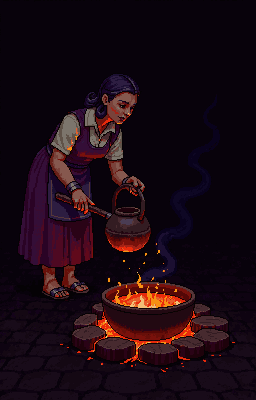
Sub-dominant
Position 2 of 8 · ☲ 離 Lí
White Dragon Horse (the silent mount)
One of the eight positions every type fills. A different function sits here in each type; below is what the position itself does, how it fails, and its eight possible hexagrams.
The dominant's opposite-attitude twin, valued only as the dominant's jump-off point: the waymaker. The best adjusted, most powerful and free of the sub-functions. 'I can see several options for who killed Mr. Body (Ne), but I sense option B is the true explanation (Ni).' Seeing it exercised for its own sake is strange, even irritating, to the type.
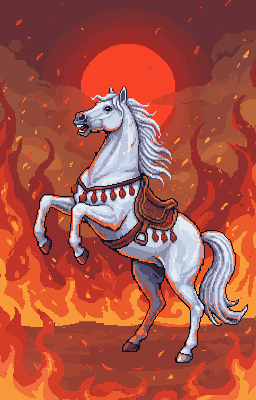
 Sub-dominant
How to read it
Audible as the quick preliminary pass the person runs before their signature move (the options listed before the verdict; the instances gathered before the archive).
The two failure directions
Every position fails in two directions: too much control (walled, refused) or too little (overrun, erupted). The two feed each other in a loop; the correction is always the opposite motion.
The eruption: Bolt ends in Drift: survey forced into a fortress of findings stops answering to the dominant at all, and the scanning keeps running with nothing to serve.
The crackdown returns: When the aimless spin finally embarrasses, the seat swings back: the Sub-dominant seizes the lead again and fortifies a new set of findings, Bolt returning harder.

too much control · correct by yield
the Sub-dominant races ahead and overrides the Dominant with raw survey, rigidifying into a fortress of its own findings

too little control · correct by hold
the survey spins for its own sake, feeding nothing back to the dominant
The arc
serves Arc 1 and 2 as the dominant's feeder; its banks are displacement-prone (Abdication at seat 1 invites Bolt here)
The four arcs and sixteen conditions in full →
The eight hexagrams of this position
Each function that can sit here forms its own hexagram (function trigram over this position's trigram), shared by the two types named.

Private conviction (Fi) sits in the sub-dominant position for ESFJ and ENFJ, directly under their group-feeling (Fe) dominant. As in hexagram 13, Fellowship with Men, a quiet personal standard supports their public warmth to build true community in the open.




Group-feeling (Fe) sits in the sub-dominant position for ISFP and INFP, directly under their private conviction (Fi) dominant. In hexagram 49, Revolution, they shed their old skin to develop a readable public face, expressing inward convictions at the proper season.